Searches such as nail charms near me, nail charms nearby, nails charms near me, bow nail charms near me and 3d nail charms near me express local intent, but this page does not claim a local storefront or nearby inventory. The same practical check applies to nail charms in store, buy nail charms, where to buy nail charms, where to get nail charms, nail charms for sale and nail charm vendors: compare current dimensions, package quantity, price and availability on the selected listing. cheap nail charms should be evaluated by fit and usable quantity rather than price alone.
Before ordering, save the exact selected option and compare the measured footprint with the intended tip or display card. Local availability language can be ambiguous, so separate three questions: whether the item exists online, whether the selected option is currently available, and whether delivery is offered to the destination. A useful comparison also considers package quantity, return conditions, surface profile and whether the style can be reordered. When a design will be sold as a repeated set, build one sample from the exact option rather than from a visually similar substitute. Photograph the sample beside a ruler and record the part orientation. This provides a practical reference if later batches or listing images change. Price comparisons should use usable pieces, not just the headline package price. A low-cost pack can be poor value when the size, curve or finish does not suit the intended layout. Keep location and price searches as research signals, then make the final decision from current product facts and project fit.
Marketplace listings can differ in quantity, scale, material wording and image presentation even when thumbnails look similar. Use a comparison sheet with columns for outside dimensions, base shape, selected color, pieces per package, current price, shipping terms and seller identification. Do not infer that a style name guarantees identical construction. When a third-party listing uses a cropped image or does not show the side profile, the missing view is a real buying risk because height and back curvature affect placement. For repeat production, order enough for a reference test before calculating a larger restock. Photograph received pieces under the same lighting and keep the supplier and option name with the sample. This makes later comparisons more objective. ZoeDIY platform-comparison copy remains informational and does not endorse or link to the named marketplaces. The current ZoeDIY listing, cart and shipping information should be checked at the time of purchase because availability and package choices can change.
International ordering should be planned around the destination, package value and the current checkout options. Review the shipping page, then confirm the available country or region in the storefront selector and at checkout. Product availability does not automatically guarantee a particular delivery speed. For a time-sensitive launch, event or client appointment, allow room for handling, transit and final quality checking after receipt. A useful receiving process includes counting the selected package, comparing color and finish under consistent light, and separating any item that differs from the approved reference. Keep the order confirmation with the product option so a future restock can be matched accurately. When several styles are combined in one set, verify every component rather than assuming one delivery estimate or one package label describes the whole order. Regional wording should never be used to imply a Canadian warehouse, local pickup point or domestic manufacturing unless the current site explicitly confirms it.
Layout planning is most reliable when each finger or display tip has a defined visual role. Choose one or two focal positions, then use quieter supporting surfaces so the design remains readable. Test the full set from arm's length as well as in a close photograph. A short surface often needs a compact base and lower height, while a longer surface can support more negative space around a tall piece. French-style layouts require special attention to where the decorative part overlaps the tip line. Dark backgrounds can absorb dark metal or painted edges, and bright blue backgrounds can compete with cool reflective stones. Use temporary placement during planning and rotate the sample under light to check reflections. Record the final order of components and the direction each shape faces. When scaling a set, repeat the approved reference instead of redesigning during production. This reduces variation and makes photography, packaging and customer expectations easier to manage.
Press-on production adds packaging and sizing constraints beyond the visible design. A raised component can prevent a tip from sitting correctly in a tray, touching a neighboring size or fitting under a protective cover. Test the smallest and largest sizes in the set, because the same piece may not suit every width. Check the side view for leverage and make sure the decorative weight does not pull the tip sideways when displayed. Before repeating a collection, package one complete set exactly as it will be shipped and inspect it after normal handling. Record the size map, component direction and any style that needs a substitute on narrow tips. Keep the selected listing and received batch associated with the reference set. When a product is offered in several colors or quantities, the exact option matters; a later order under the same product title can still differ if a different variant is selected.
Character-inspired shopping requires careful separation between a search phrase and a verified product statement. A customer may use a familiar name to describe a color palette, silhouette or general aesthetic, but that does not establish licensing, authenticity or brand affiliation. The safe workflow is to open the current collection or listing, read the exact product title, inspect the images and buy only what is actually shown. Avoid rewriting a generic component as an official branded item. For merchandising, describe observable features such as color, shape, expression, finish and size rather than adding unsupported identity claims. If a design will be sold in a finished set, the seller should independently review applicable intellectual-property and marketplace rules. Inventory can also change quickly, so do not promise that a character style will remain available. Keep a dated reference image and selected option with the sample used for photography, and use neutral replacement language when the exact style is no longer listed.
Niche entertainment searches often have low overlap with the actual store taxonomy. A visually similar piece should not be treated as an exact match merely because it shares a color or mood. Use the product title and images to determine whether the motif is truly present. When no exact current item is available, keep the search phrase informational and route customers toward broader verified collections rather than forcing a product link. This approach protects accuracy and makes the page easier to maintain. For themed sets, define the observable design brief first: dark palette, playful figure, graphic silhouette, pearl movement or another concrete feature. Then select components that meet those requirements without making an unsupported affiliation claim. Test the finished layout for scale and readability. A detailed motif can disappear on a very small surface, while a large piece can dominate the set. Maintain a reference sample so later substitutions are evaluated against the same visual and physical criteria.
Designer-name and crystal-brand searches create a higher risk of misleading product language. A metallic color, monogram-like pattern or faceted stone does not prove that a component is made by, authorized by or connected with a named company. Keep these phrases in comparison or clarification copy only. The current listing should be described by its observable form, finish, dimensions and package option. Do not add authenticity, precious-material or branded-crystal claims unless the listing and supporting records clearly establish them. For resale or finished-set marketing, independently review the platform and intellectual-property rules that apply to the seller. From a design perspective, compare the visual effect without relying on the name: polished gold tone, clear faceting, dark graphic pattern, small emblem or another accurate feature. This creates more durable copy and helps customers understand what they are actually choosing. Store the received sample and listing details together, especially when a later restock may have a similar appearance but a different specification.
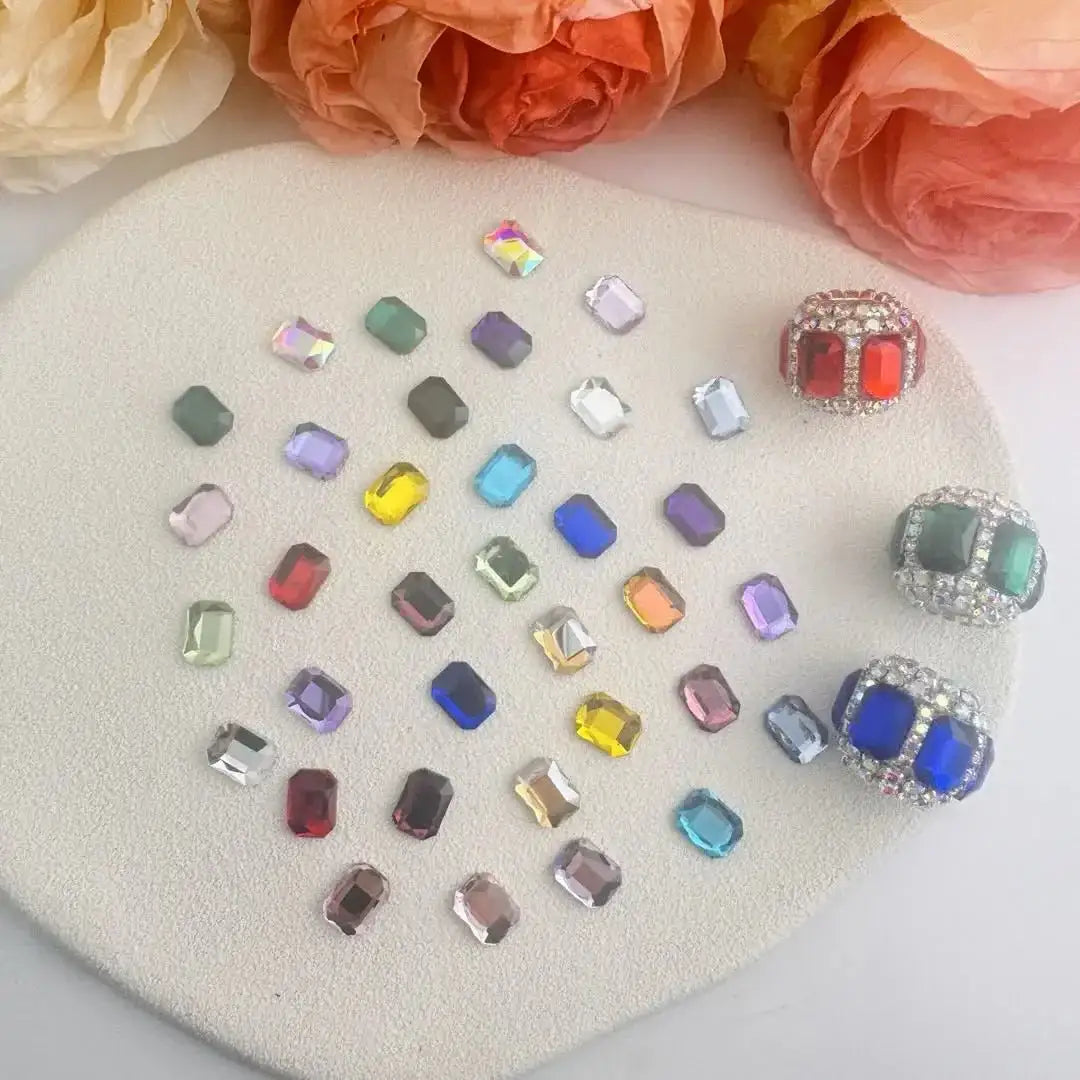
Rhinestone-style selection should start with the measured face and the shape of the back. A flat-backed piece, framed setting and raised cluster can require different placement even when their front dimensions are similar. Compare color under neutral and warm light, then place one sample on the intended background. Reflective pieces can visually expand, so spacing should be judged in the complete layout. For wholesale planning, count how many stones are used per finished set and include a testing allowance before choosing the package quantity. Keep the received batch separate until color and brightness are compared with the reference sample. Avoid describing a generic faceted part as a named crystal brand without supporting documentation. The verified Crystal Glass route is the appropriate place to browse the current range, while individual product pages remain the source for size, option, quantity and price. If a design mixes stones with painted or resin parts, make sure harder edges do not repeatedly rub against softer surfaces during storage.
Attachment decisions depend on whether the project is a display sample, a craft component, a press-on set or a professional service. Household super glue is not a universal substitute for a system designed for the specific surface. It can be difficult to control, may damage some materials and can create an unsafe result when used without appropriate knowledge. For non-wear craft tests and removable display placement, Nano double sided tape can help hold a sample temporarily while proportions are reviewed. It should not be described as a universal professional nail attachment method. Follow the instructions supplied with the intended professional system and seek qualified guidance for natural-nail application. Before producing a repeated set, test the actual component, surface preparation and curing or holding process used in the final workflow. Inspect the finished sample from the side, check for gaps and verify that the component remains within the planned packaging clearance. Keep materials labeled so products with different intended uses are not mixed.
Combining decals with raised components works best when one element has visual priority. Place the flat artwork first and check whether the dimensional part covers an important line, word or focal image. Leave enough clear space around the raised edge to prevent the design from looking crowded. A display board can compare several arrangements quickly, but the final decision should still be checked on the real tip size and curve. Photograph each approved layout with a simple code or component list. This creates a repeatable reference for later production and helps identify which item changed when a restock looks different. Store unused decals flat and keep dimensional pieces separated by finish so hard edges do not scratch reflective faces. When a design will be sold, the display should match the actual components and selected options. Avoid using a sample made with one size or color to represent a different variant without a clear note.
Themed Halloween layouts often combine dark metal, bright enamel, reflective stones and complex silhouettes. Check the design under normal room light, because black-on-black details that are visible in a close photograph may disappear at viewing distance. Raised points, legs or open shapes need enough space around them to remain readable and to avoid contact with neighboring fingers or packaging. Build one complete sample with the actual tip sizes, then inspect the side profile and the way the set sits in its box. Photograph the approved layout against a neutral background as well as the intended promotional background. This helps distinguish product detail from styling effects. When planning a seasonal quantity, calculate the number of components per set and the realistic sales window before choosing a larger package. Keep leftover themed parts labeled so they can be evaluated for future collections without being confused with a different finish or size.